

The women's category of Olympic sports will be limited to biological females from 2028.
The International Olympic Committee (IOC) says eligibility will be determined by a "once-in-a-lifetime" sex test, which would prevent transgender women and those with differences in sexual development (DSD) who have gone through male puberty from competing.
It will take effect from the Los Angeles Olympics.
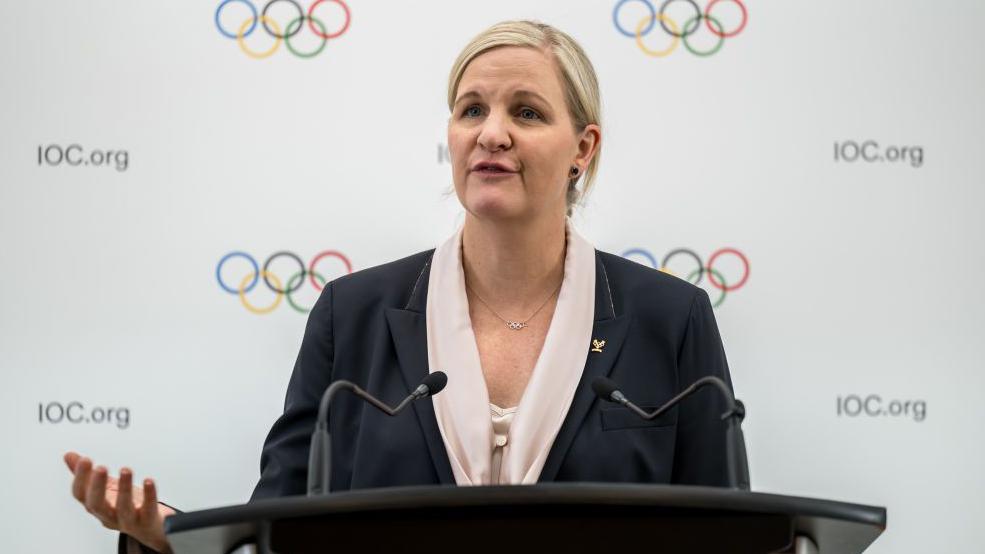
IOC president Kirsty Coventry said the policy was "led by medical experts".
"At the Olympic Games even the smallest margins can be the difference between victory and defeat," she said.
"So it is absolutely clear that it would not be fair for biological males to compete in the female category. In addition, in some sports it would simply not be safe."
The IOC said eligibility for the female category would be determined by a screening to detect the SRY gene - the sex-determining region Y gene - which is part of the Y chromosome and causes male characteristics to develop.
"The IOC considers that SRY gene screening via saliva, cheek swab or blood sample is unintrusive compared to other possible methods," it said.
"Athletes who screen negative for the SRY gene permanently satisfy this policy's eligibility criteria for competition in the female category.
"Unless there is reason to believe that a negative reading is in error, this will be a once-in-a-lifetime test."
The IOC said athletes who fail the test would "continue to be included in all other classifications for which they qualify. For example, they are eligible for any male category, including in a designated male slot within any mixed category, and any open category, or in sports and events that do not classify athletes by sex."
Until this announcement, the IOC left sex eligibility regulations to the governing bodies of individual sports, rather than applying a universal approach.
While athletics, swimming, cycling and rowing have brought in bans, many others allowed transgender women to compete in female competition if they lowered their testosterone levels.
New Zealand's Laurel Hubbard became the first openly transgender women to compete at an Olympics after being selected for the women's weightlifting team at Tokyo 2020.
But by the Paris 2024 Games, there were not known to be any transgender women competing in the women's section due to the bans.
There was, however, controversy in the boxing after Algeria's Imane Khelif won the women's welterweight boxing gold medal, a year after being disqualified from the World Championships for reportedly failing a gender eligibility test.
Some reports took the IBA saying Khelif has XY chromosomes to speculate that the fighter might have DSD. However, the BBC was not able to confirm whether this was or was not the case. Khelif has always insisted she is a woman and told CNN earlier this year that she would take a sex test to compete at LA 2028.
The IOC's ban will also cover almost all athletes with a DSD.
The Guardian reported in September that between 50 and 60 athletes who went through male puberty had been finalists in the female category in global and continental track and field championships since 2000.
This is a rare condition in which a person's hormones, genes and/or reproductive organs may be a mix of male and female characteristics.
Two-time Olympic women's 800m champion Caster Semenya's DSD means she has male XY chromosomes.
Previously, DSD athletes who had been through male puberty could compete in women's sport, provided they kept their testosterone within certain levels.
There is an one exemption in the policy for DSD athletes with a rare condition - complete androgen insensitivity syndrome (CAIS), which means they have not gone through male puberty.
